“A lot of people are afraid of heights. Not me, I'm afraid of widths.” - Steven Wright
The Only Rule I Follow
I follow one rule, and I've followed it for years now: five days a week, come hell or high water.
That's it. That's the whole rule.
But here's the part that took me a long time to figure out: the rule is only about whether I exercise, not what I do. That distinction is one reason this has lasted when everything else didn't.
Because when the question is " Am I going to exercise today," I've got endless ways to talk myself out of it. But when the question is already answered — when it's “I am going to exercise today” — there's nothing left to negotiate. The decision was made a long time ago. All that's left is picking something.
And that's the loose part. The “what” is whatever I feel like at the moment. I honestly don't know what I'll be doing until I wake up and decide.
Maybe I feel like staying in with the dumbbells or the resistance bands. Maybe it's a beautiful day, and I want to get on the bike. Maybe my knees are feeling good, and I want to jog in the park. Maybe I want to do a shoulder day, or a leg day, or something I haven't done in a while.
The only thing that matters is that I'm doing something.
So, my routine is both rigid and loose at the same time. Rigid about the days. Loose about everything else. I've found that combination works for me personally, and I think it's one of the main reasons I'm still doing this after all these years instead of quitting like I used to.
If you're the kind of person who likes to do certain muscle groups on certain days, and having a plan mapped out ahead of time is what makes you show up — do that. That's genuinely not what works for me, but it isn't wrong.
My way of doing things certainly isn’t the only way. The only right way is the one that keeps you showing up consistently.
Why Five Days?
It's five for two reasons: what I've decided I'm willing to commit to, and what I want to protect.
First, I like to exercise before work. That's when it happens, and it happens before the day gets its hooks into me. Second, I want my two days off — not just off work, off exercising. Those two days belong to my son and to the things I never get to during the week. If you try this, you may find your scheduled days off feel sweeter than they did before, because you earned them.
And honestly? Five is what it evolved into. I didn't set out to land on five. I started with one set of push-ups a few times a week, and over the years it grew. It's become my sweet spot — enough that I'm getting the benefit, not so much that I quit.
My Home Workout Menu
Pick a row, choose one or more options from it, and do a few sets. That's the whole system.
WHAT OPTIONS
Chest Push-ups, Band flys
Back Rows, Deadlifts
Legs Squats, Lunges, Leg curls, Calves
Shoulders Front raises, Lateral raises, Band rehab
Arms Dumbbell curls, Dumbbell hammer curls, Skull crushers, Dips
Core Sit-ups, Planks, Farmer's carry
Cardio Walk, Bike, Walk with the vest, Jog
This group of exercises has definitely grown over the years. I don’t do all of these in one day. I might not even get to all of them in a week. It doesn’t matter. I simply pick a row and get started on one or more in that row. If I want, I pick another row and do something there too.
One thing off this list is a good day. Two or more is a great day.
Shoulders: Raises and Rehab
My shoulders are bad, and they've been bad for years. That's why this section has two halves: work that builds the shoulder, and work that keeps it healthy. They're different jobs, and you need both.
Front Raises
I usually start with the twenty-five-pound dumbbells. These are the weights I’m using. Go lighter or heavier depending on where you’re at. It’s all about doing the exercise correctly.
Palms facing your thighs, slight bend in the elbows, and raise the weight slowly until your arms are parallel to the floor. Then lower it just as slowly back to the start. I do as many as I can until I can't do them with good form, then immediately drop to the ten-pound weights and keep going. Two or three sets.
Lateral Raises
Same weights as the front raises, but these are a different animal. Feet about shoulder-width apart, knees slightly bent, palms facing in and mirroring each other in front of you.
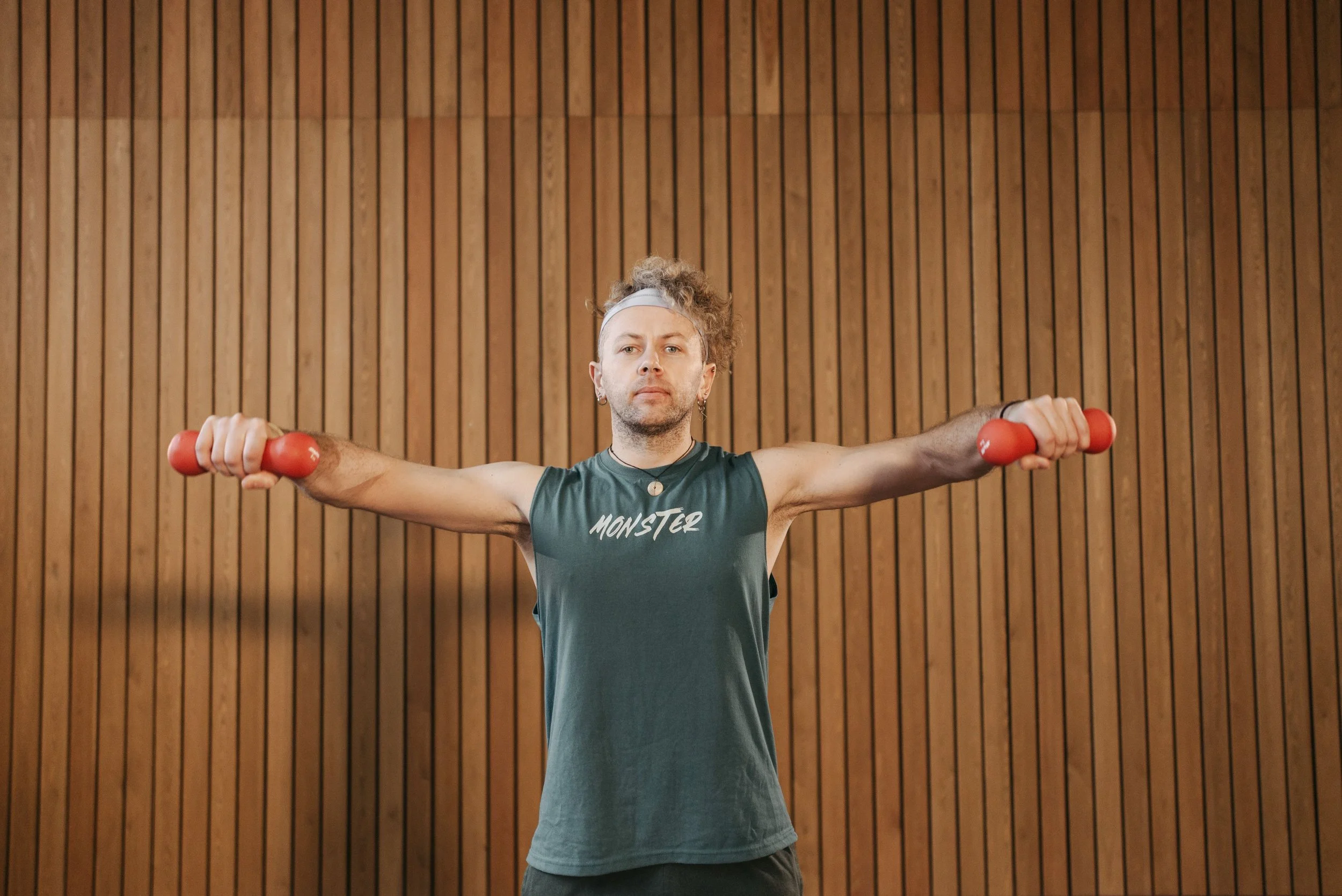
Here's the part that matters: lead with your elbows, not your hands. Your hands are just along for the ride. Raise your arms out to the sides with your elbows and knees slightly bent, and when your elbows reach parallel to the ground, gently turn your wrists forward like you're pouring water out of a glass. Then bring everything back to the start, slowly.
Same approach as the front raises — reps until your form goes, then drop to the tens and finish. Two or three sets.
Band Rehab
These are the exercises my doctor gave me for my shoulders, and you can't do them with dumbbells. This is another reason I own resistance bands. Light resistance, high reps, no ego.
external rotation
Anchor one end of the band to a table so it won't slide. The other end has a handle on it.
If I'm working my right arm, I stand with my elbow bent at 90 degrees and my palm against my midsection. I position myself so the band has no slack in it. With my elbow tucked against my side, I slowly rotate my forearm outward as far as it'll go, then slowly bring it back.
One thing to watch: don't let your body or shoulder turn as you rotate. If your torso is twisting, you're using your whole body to move the band instead of your shoulder. This is all forearm and shoulder joint. Low resistance, 3 sets of 15 to 20 reps, then switch arms.
Internal Rotation
Same anchor, same setup, opposite direction. I can handle a little more resistance on this one.
Elbow bent at 90 degrees and tucked against my body again — but this time I start with my hand out and pull in toward my midsection, then slowly return to the start. 3 sets of 15 to 20 reps, then switch arms.
Chest: Push-Ups and Band Flys
Push-Ups
In my opinion, this is one of the best exercises there is. You don't need any equipment, and there are variations for whatever level you're at.
How many reps you can do is unimportant. It's all about form. Here's what I mean by that: keep your body in one straight line from your head to your heels, hands about shoulder-width apart, and lower yourself under control instead of dropping. Elbows back at roughly a 45-degree angle from your body, not flared straight out to the sides. Breathe — exhale as you push up, inhale as you lower. And never let your hips sag, or your butt drift up toward the ceiling.
If you can't touch your chest to the floor, that's not a problem. Try them on your knees or use the kitchen counter instead. If that's still too much, do them against a wall. Same form rules apply at every height, and the higher your hands, the easier it gets.
Band Flys
I anchor my bands at the top of my door. I stand with my feet about shoulder-width apart and bend slightly at the waist, with my elbows fixed and slightly bent. From there, I bring my hands together in front of my chest — sort of like I'm hugging a barrel — then return to the start, keeping tension on the band the whole time.
Two form notes specific to these. Don't let the band snap your arms back at the end; keep the tension by controlling the return. And keep your elbows locked in that slight bend throughout — if they're bending and straightening, you're turning a chest exercise into a triceps exercise.
I like doing high reps here. At least 10 to 12, and more if I have it in me. Set your resistance so you can do these with good form — if the band's too heavy, you'll end up using your back and shoulders instead of your chest. I usually do about 3 sets.
Back: Rows and Deadlifts
Single-Arm Dumbbell Bent-Over Row
If I'm starting with the dumbbell in my left hand, I put my right hand on the frame of my bed. The arm of your couch or a chair works too. My right leg is forward, and my left leg is back.
I pull the dumbbell back toward my left hip. That's the part people get wrong — it's a pull toward your hip, not a curl up toward your chest. Let your back do the work. Stay mindful of two things: don't twist your spine, and don't let your bicep take over the movement. If your elbow is doing all the bending and your back isn't doing any of the pulling, you're training the wrong muscle.
Dumbbell Deadlifts
Start lighter than you think you need. You can always add weight later, and you can't un-hurt your back.
I set the dumbbells in front of me and engage my core before I go anywhere. Then I bend at the hips with a straight back, knees slightly bent — remember, these aren't squats, but my knees aren't locked either. When the weights have gotten just past my knees, I push through my heels back to the starting position.
I usually do about 2 or 3 sets of 8 to 10 reps.
Once you're comfortable with both of these, you can finish with a drop set — do your heavy set, then immediately switch to a lighter weight and keep going. I explain how in my post about my home gym equipment.
Legs: Squats, Lunges, Leg Curls, and Calves
Bodyweight Squats
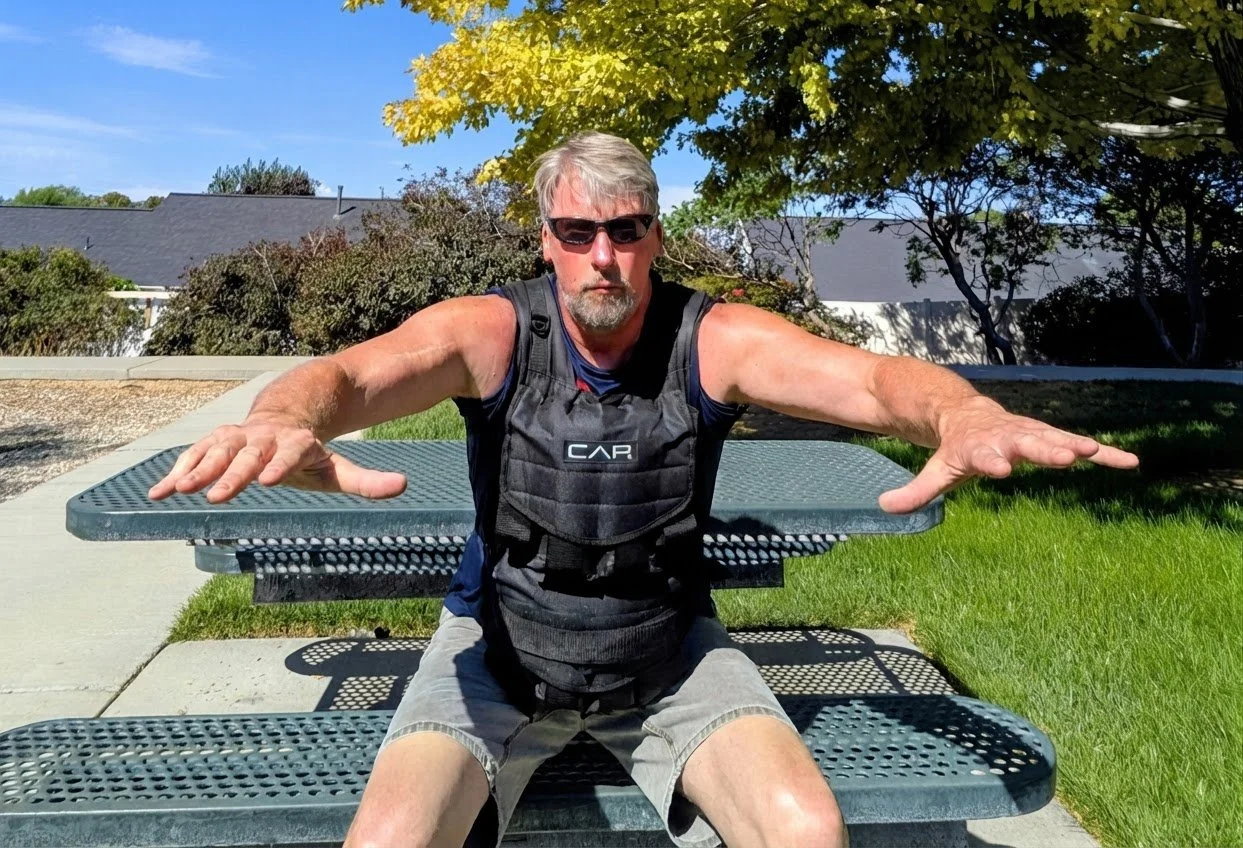
I started with no weight at all years ago and gradually brought in the weighted vest. Whether you use extra weight doesn't matter — the movement is the same either way. Start with none.
With your chest up and arms straight out in front of you for balance, lower yourself to a bench or chair. Ideally, your thighs are parallel to the ground, but that depends on how your knees feel that day. Then push through your heels back to standing.
I usually do several sets of these, and I do them on my walks. There's a park near my house with five or six benches around the perimeter, so I walk the loop, and when I come to a bench I do about ten squats. By the time I've finished the loop, that's fifty or sixty squats and a good amount of walking. Two things done at once.
Lunges
I used to do these weighted — the vest or dumbbells. After both my hips were replaced, I scaled back to bodyweight, and I'm almost ready to add weight again.
You can step forward or backward. I step backward because it takes pressure off the knee and puts more of it on the glutes.
As I step back, I bring my knee down to the floor or close to it, then drive through the front heel to return to standing. Three sets of ten, then switch legs.
leg curls
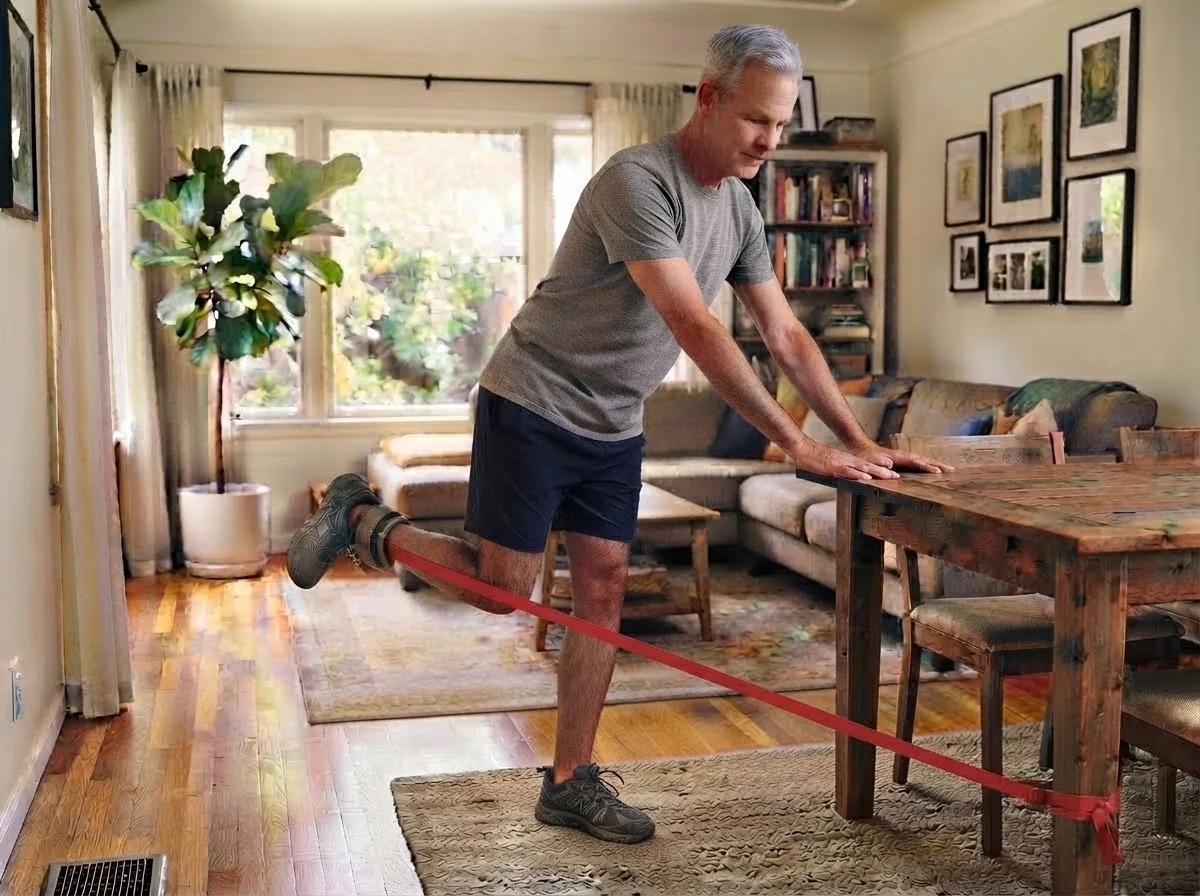
Resistance bands are the best way I've found to do these at home, and they do a great job on the hamstrings — a muscle group that's hard to work without them.
I anchor one end to a heavy table that won't slide and strap the other end around one ankle. Hands on the table for balance. I slowly bring my heel up toward my rear end, then control it back down to the start.
Three sets of ten, then switch legs.
Calves
I like these because they're easy, and a step gives you the full range of motion. This is another one where I use the vest.
Working my left calf, I let the right foot relax out of the way. Toes pointing forward, on the ball of my foot, I slowly lower until I feel a good stretch. Then I push through the ball of my foot and rise as high as I can, hold for a beat at the top, and repeat.
High reps on these — usually 15 to 20, about three sets, then switch to the other calf.
Arms: Curls, Dips, and Skull Crushers
I like doing arms in the same way I like doing calves: they're easy, and you can go to failure without worrying about getting into trouble the way you could with squats or lunges. If your arms give out, you set the weight down. If your back gives out mid-deadlift, that's a different story.
Dumbbell Curls
I usually start with the 40s and do as many as I can, which isn't many. Then I immediately drop to the 25s and go until my form breaks down. Two or three sets to failure.
Hammer Curls
Hammer curls help build the biceps and the forearm. Instead of holding the dumbbell with your palms up, the dumbbells stay vertical with your palms facing inward, like you're holding a pair of hammers. Same approach as regular curls — start with the 40s, finish with the 25s. Two or three sets to failure
Skull Crushers
Lying on my back, I hold the 25-pound dumbbells above my chest with my palms facing inward. I slowly lower the dumbbells toward my head—or just to the side of it. Elbows stay straight without flaring outward. This is not a press; it's all elbows, no shoulders. Then I extend my elbows back to the starting position.
I go until my form starts to fail, then immediately grab the 10-pound dumbbells and continue slowly until failure.
Dips
I use a countertop or a couple of chairs pushed against a wall. Palms on the edge, heels on the floor. My elbows are behind me — not perfectly straight but not flared out to the sides either. I slowly lower myself until my shoulders drop below my elbows, then press through my palms to straighten back up.
Three sets, to failure.
Core: Planks, Carries, and Sit-Ups
Planks
There are a few variations of this exercise. To be honest, I've only ever done two: the full plank, where you're up on your hands like the top of a push-up, and the elbow plank, where you're on your forearms instead. I'll describe the elbow plank, since it's the one I do most.
Face down, up on your elbows. Your hands aren't flat — they're facing inward, either relaxed or in a loose fist. Forearms shoulder-width apart and flat on the floor. Your body stays in one straight line from your head to your heels.
Two things to watch: don't look up, or you'll strain your neck and your back, and don't let your hips sag or drift up. Keep your core engaged the whole time you're holding the position.
I time these rather than count reps — start at twenty seconds and build from there.
Carries
These are sometimes called farmer's carries, and they're another easy one that does more good than you'd think.
Just grab a couple of dumbbells and start walking. You can go heavier than you'd expect on these. Palms facing inward, walk around the room for a bit. Use one in each hand or carry one and then switch sides.
The form cues that matters: stand tall. Don't lean. If you're tilting to one side, the weight's too heavy.
Sit-Ups
When I first started these years ago, I anchored my feet under the couch. After reading up on it, I realized that wasn't the best way to go about it — with my feet anchored, I was working the hip flexors more than the abs. So, I stopped anchoring, and I was surprised how much harder it is when the abs are actually doing the work.
Do these on carpet like I do or get a mat. I'll either cross my arms over my chest or put my hands by my ears. What you definitely don't want is your hands behind your head, pulling your neck forward. I curl my torso up toward my hips, then lower slowly back to the start. I repeat until I can't do any more.
When I get there, I hold near the top and slowly rotate my torso left and right. I really feel it in the flanks — the love handles.
I go to failure on these. Usually just one set, but I do them several times a week, because core has always been one of my weak points.
Cardio: Bike, Walking, and Jogging
The Bike
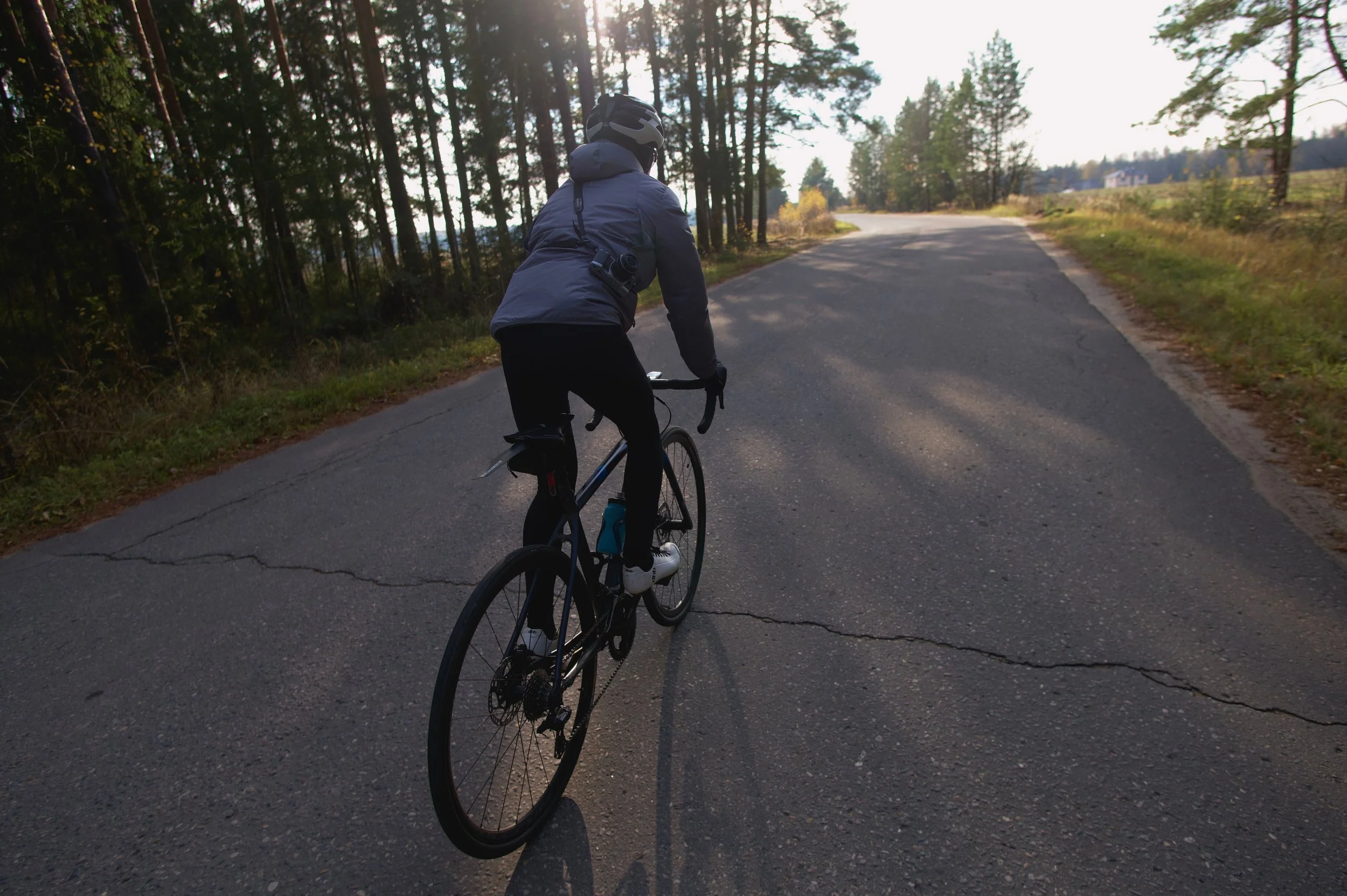
This is the best piece of equipment I own. It's an amazing leg workout, and the aerobic cardio is exactly what I'm looking for. It builds my leg muscles and helps me keep my weight down — two of my historical weaknesses. If you don't already have one, I'd strongly suggest getting one. A used one is fine.
walking
This is my go-to when every fiber of my being is trying to talk me out of doing anything. When I've got a bad case of the fuck-its.
Why? Because it's easy, plain and simple. Walking is a great aerobic exercise when I'm in a good mental place, too. But when things go sideways, this is the one I can rely on to keep the consistency ball rolling.
Walking With the Vest
My hip surgeon suggested that a little extra weight while walking would be good rehab. He said a bookbag filled with books — or whatever's lying around the house — and a walk would do the trick. I already owned a weighted vest and hadn't thought of using it that way. He was right.
After the hips healed, I kept using the vest. Why? It adds a little something to my legs, glutes, shoulders, and traps, and it gets my heart rate up a tick more than walking without it.
Jogging
I love jogging, but it doesn't love me. The endorphins are wonderful, but my knees pay the price for a few days after. So I listen to my knees. When they give me the green light, I go.
Two things I've learned: jogging on grass is easier than concrete, and jogging uphill seems to have less impact. Bottom line — listen to your body.
summary
”Take care of your body. It’s the only place you have to live.” - Jim Rohn
Here's the part I want you to take away from all of this: I don't have a workout plan. I have a simple routine.
Five days a week. That's it. What I do on those days’ changes constantly, and that's deliberate. Some days I lift. Some days I walk. Some days I get on the bike because it's beautiful out. Some days all I've got in me is a walk around the park.
What matters isn't what you do. All that matters is that you do something, anything at all. Showing up is the hard part; the rest is easy — because you're not negotiating anymore; you're just picking.
You don't need a gym. You don't need a rigid plan. You don't need to know what you'll do on Wednesday. You need a few days a week, a couple of options, and the willingness to stay consistent.
Start with two days if five sounds like too much. Start with two minutes if even that feels like a lot. Twenty seconds of plank counts. A ten-minute walk counts.
Just get started; it gets easier after that.