“Many of life’s failures are people who did not realize how close they were to success when they gave up.” — Thomas Edison
The Pattern I Couldn't See
I always loved sports growing up. Because of that, I was usually on some kind of team, which meant I always had a coach dictating how to work out, how much, how often, and how long. Run, jump, do drills, repeat. I'm not saying that was a bad thing — I learned a lot from team sports. Unfortunately, it's also where I learned to hate working out.
I've started and quit working out so many times over the years that I can't even count them. And every time I quit, I thought it was a character flaw. I just didn't have the discipline to exercise consistently. That was the story I told myself for decades.
It took me a long time to realize the flaw wasn't in my character. The flaw was in the pattern I was stuck in — and the pattern was the same every damn time.
Looking back, I feel a little disappointed that I couldn't see it sooner. I think that's because I didn't believe there was another option. Exercise, to me, meant going harder than I wanted to, day in and day out. Somebody else deciding. If that was what it took, then I was simply not the kind of person who exercised.
I know now that isn't true. That belief didn't just keep me from exercising. It set up every failed attempt that came after.
Reason One: I Went All In
Every time I quit, I went through the same stages. First, I'd make excuses and justify quitting. Then came the guilt and shame. Then came the atrophy and the weight gain.
Over time, I'd slowly talk myself into some phony motivation. And I'd always add the same condition: I knew I had to give up all the foods I loved, too.
Next came the plan. Five or six days a week, at least an hour in the gym. Because I ain't gettin' eight-pack abs and huge guns doin' it any other way. Half-assing it ain't gonna cut it, so LET'S GO!
Underneath that was an even sillier idea: that the longer I spent in the gym, the better. If forty minutes was good, ninety had to be better, right? It never would have occurred to me to cut the hour in half, or to do ten minutes and call it a win. More had to mean better. That's the kind of thinking that kills a routine before it starts.
Holy shit, talk about a lack of self-awareness. That awful plan was pretty much the same every time, and it was doomed before it ever started. Why? Because it wasn't my plan. It was a plan for the person I thought I needed to be — not who I actually was.
Eventually, a few months in, I'd miss a day. No big deal, it's just a day. The problem is, one day easily slipped into two. Then a week. And before I knew it, I was on the bad side of the pattern again.
I could have saved myself a lot of heartache by taking the time to figure out what I was willing to do. Sure, looking like the people in magazines would be awesome. But the problem for me was — and still is — that I'm not willing to do what it takes to get and keep a body like that. And that's okay.
A younger me would have considered that a weakness. Now I think understanding yourself is an incredible strength.
That was step one for me: figure out what you're willing to do consistently and go from there.
Reason Two: I Was Waiting to Feel Like It
If I added up all the time I've wasted waiting for the right moment to start, it would come to years. My motivation and attitude had to feel just right before I could begin. Wow, what a waste of time.
I learned later that, for me, motivation almost always shows up after I get started. If I only exercised when I felt like it, I wouldn't very often.
I used to be able to force myself to the gym for a few weeks, sometimes a few months. But eventually there would come a day after work — and it had been a day — when I just said fuck it. I didn't have an hour in me. I didn't want to deal with people. I didn't want to wait for a bench or a machine. It may have been leg day, and I sure as hell didn't feel like doing squats. I didn't even feel like driving there.
My mistake was letting how I felt decide whether I exercised. Relying on attitude and motivation was a fool's errand too. Motivation is great when it's there. Unfortunately, relying on motivation is like relying on that "friend" who's let you down several times before. Eventually, it's on you.
That's the problem. The fix took me years to find, and it came down to one thing: I stopped asking myself whether I felt like it, and started deciding in advance that I was going to do something. Not am I going to exercise today — I am going to exercise today. Once that's settled, the motivation has nothing left to decide.
Reason Three: I Thought There Was Only One Right Way
I had a rule that I learned early on, and I never questioned it: certain muscle groups on certain days. Monday was chest and tris; Wednesday was back and bis, etc. It sounded disciplined; hell, it even rhymed. But for me, it was just another trap.
Because the moment my plan and my day disagreed, the plan won and I lost. If Wednesday was back day and I didn't feel like doing back, I skipped the whole day. Not "I'll do legs instead." Not "I'll take a walk." I skipped. The schedule said back; I didn't want back, so I chalked up a zero.
Same thing at the gym. My version of a workout had to fit into a specific mold — a building, equipment, an hour. Anything that didn't fit, didn't count as exercise at all.
The fix was simpler than I want to admit: I stopped scheduling exercises and started scheduling days. It eventually grew into five days a week, and whatever I do on those days is up to me that morning. The only rule left is that I do something.
That single change is one of the main reasons I'm still doing this. Every other plan I made had the opposite built into it.
Reason Four: The Gym Was All or Nothing
“Success is usually the culmination of controlling failure.” - Sylvester Stallone
Growing up, and well into adulthood, I believed people who exercised at home couldn't be as serious about getting fit as people who went to the gym. I mean, look at the place. Tons of equipment. Mirrors on every wall. A whole culture built around it. That's what my ego told me for a long time.
And my ego set me up for failure, because the gym being the only real option gave me a hundred ways to quit. When I didn’t go to the gym, I didn’t exercise at all.
What I couldn't see was that I'd made the place the requirement instead of the movement. The gym wasn't the exercise. It was just one of the rooms I could have done it in.
The best thing I ever did for my exercise habit was cutting the gym loose. It was like setting down a bag of fucking bricks. If you love the gym, by all means, go. But if any of this sounds like you, do yourself a favor and let it go.
And if you decide later that you need it back, no problem. They'll take you and your money back in a New York minute. I promise.
Reason Five: Pain as Proof
I grew up with a "no pain, no gain" mentality when it came to sports and working out. Competition was high, and comparison — at least in my mind — was constant.
In some situations, like high school and college sports, that mentality isn't necessarily a bad thing. As long as your injuries aren't serious, and as long as you don't grow to hate working out the way I did.
The "go hard or go home" attitude I developed at a young age took a long time to unpack, look at honestly, and admit it wasn't serving me anymore. And that attitude had a cost I didn't see for years.
Pain isn't only physical. The mental pain can be far worse. The emotional pain of quitting, even when it's self-induced, is hard to carry — not just the difficulty of starting exercise again, but the difficulty of finding the courage to start anything new at all.
I remember vividly my basketball coach calling me into his office because he'd heard I wanted to quit when the season was over. He told me that once you start quitting on yourself, it gets easier to quit on yourself in the future. I was twenty years old and angry, so it was hard to hear — especially since he was part of the reason I was quitting. But seeing it clearly now, I know he was right.
So I say let's set this game up to win. Let's make it so easy that quitting seems ridiculous. I know in my heart that almost anyone can do what I'm doing, because there's nothing special about me. I go into that in detail in my post about how to start exercising when you're out of shape.
Reason Six: I Was Doing It for the Wrong Reasons
As a younger man, my reasons for exercising were superficial. Working out to look better in the mirror motivated me for a little while, but it wore off fast.
Finding the right reasons got easier as I got older. They pretty much slapped me across the face. That happened around the time I got close to 300 pounds, with high cholesterol, high blood pressure, joint problems, and a few other things I'd rather not list.
Another reason I stay consistent today is the sense of control I feel when I exercise. You might be thinking, Hey Kevin, how much control do we really have in life? We could die tomorrow. I absolutely get it. But I'm not making a claim about fate here — it's how it makes me feel, and that's good enough for me.
Dealing with depression and having dementia in the family lit a fire under me too. Exercise doesn't cure either one, but it's been shown to help.
I had to find enough "whys" for this experiment to get real. In other words, enough reasons to keep going when motivation disappears, when my attitude sucks, when I don't want to work out at all.
Your "whys" are probably different from mine, and that's fine. If looking better in the mirror is one of them, that's okay — as long as you have some others with a little more substance behind them. Finding my personal "whys" has been one of the most helpful things I've done. I sincerely think it can help anyone.
And here's what happens if you stay with it. If you stay consistent long enough, you develop a habit. If you let the habit continue, you develop an identity. That's when it gets even easier.
The One Change That Broke the Pattern
“I already know what giving up feels like. I want to see what happens if I don’t.” – Neila Ray
Change has always been hard for me. It's probably why it took me thirty-plus years to realize what I'd been doing wasn't working.
Eventually, I got sick of doing the same shit over and over and ending up in the same place.
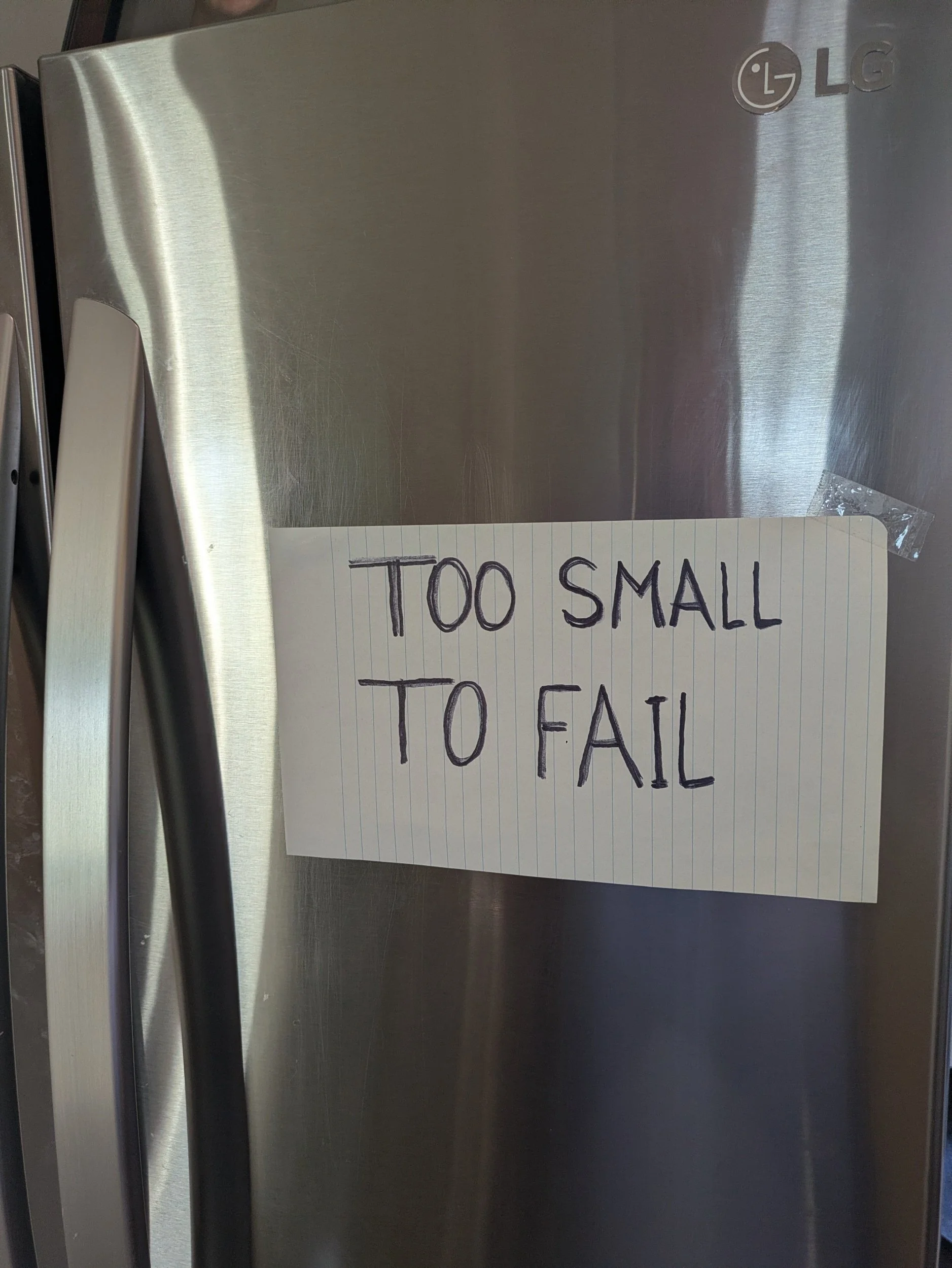
So I did the opposite of what I'd always done. I didn't need the gym, or a rigid plan, or more motivation. I needed a smaller starting point. I made this thing too small to fail.
It started with one set of push-ups a couple of times a week. Everything grew from there. Motivation showed up after I took action. My reasons evolved. The routine grew into a habit, and the habit turned into part of who I am.
summary
"Age wrinkles the body. Quitting wrinkles the soul." — Douglas MacArthur
In this post, as in every post, I try not to sound like I'm preaching. Why? Because it would make me want to vomit on my own shoes.
I certainly don't know everything. I've learned a lot, and I'm still learning — which is why I named this site The Ungymed Experiment. I only know what works for me. But for the first time in my life, I've found a way to exercise consistently for years. Something I couldn't pull off even when I considered myself an athlete.
That's why I got excited and built this website. Maybe someone out there reads this and gives it a try, and it helps them somehow. That's the hope, anyway.
If you've quit a zillion times like I have, you're not broken. You've just been running the same pattern over and over. Change one thing — make it small enough that a bad week can't wreck it — and find out what your future self looks like.