“This is the meaning of the phrase atomic habits—a regular practice or routine that is not only small and easy to do, but also the source of incredible power; a component of the system of compound growth.” - James Clear
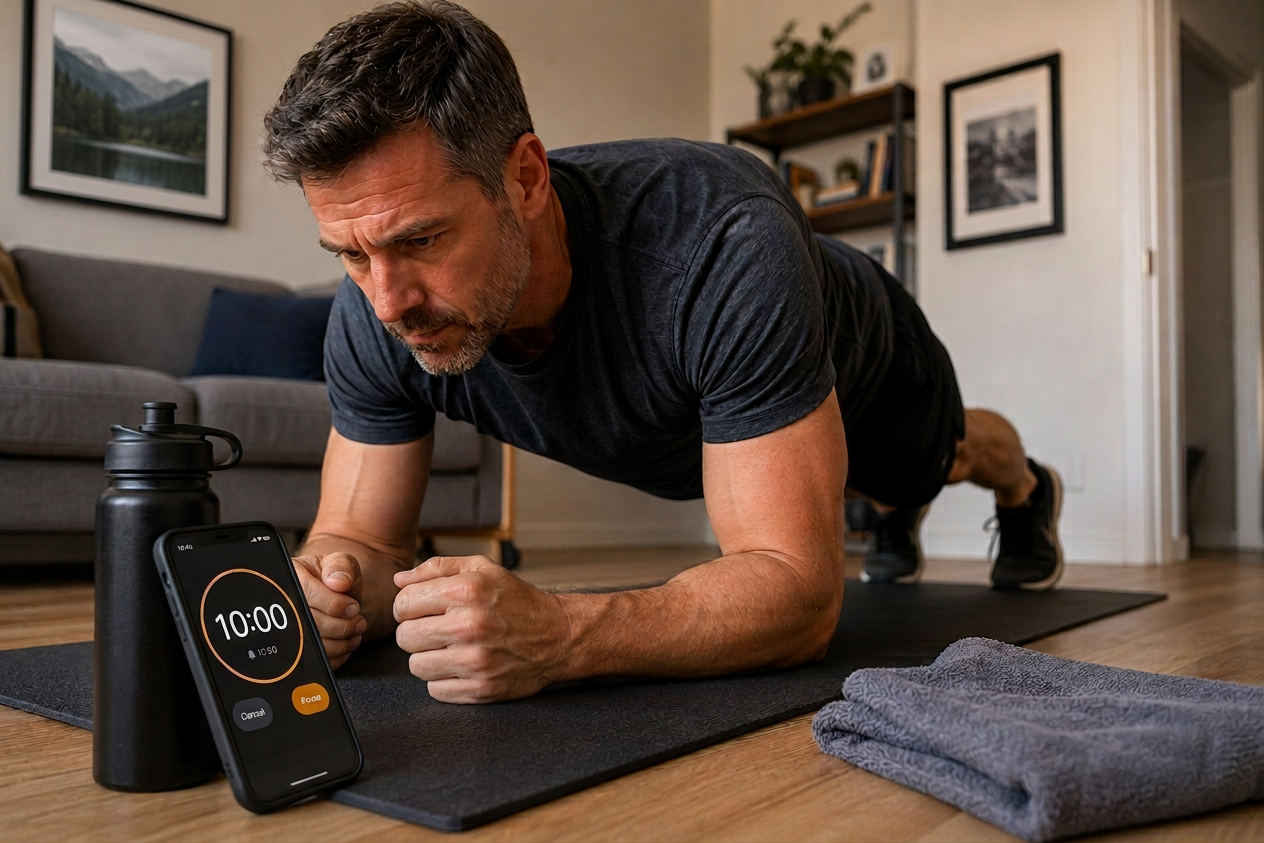
Why Time Isn't the Real Problem
Most people aren't lacking time. They're lacking a routine that fits the time they have.
I know we're not all cut out like cookies — everybody's life and schedule is different. But in broad strokes: most of us work about eight hours a day and sleep about eight. That leaves roughly eight hours for everything else.
Now, that's not true for everyone. I've got an hour commute each way, five days a week, so that's two hours a day I don't get back. By the time it's over, I've got closer to six hours left, not eight.
And it doesn't matter. Six hours is still plenty of time to build a routine I'm willing to stick with.
Frequency Beats Duration
For exercise to actually work, it has to become part of your life.
Not a phase, not a challenge — part of your life. And the only way something becomes part of your life is if it's easy enough to live with. Life is already hard. Add another stressor to it, and you'll drop it. That's what I did for thirty years.
Ten minutes five days a week beats an hour twice a week. The reason isn't physical — it's that five small wins make it easier to keep showing up over the long run. It builds a habit that can grow into whatever you're eventually willing to do.
So, the question isn't "how long should I work out." It's "how do I make this easy enough that I'll still be doing it in two years?"
In my opinion, it's not about how long you work out. It's about how many times.
How Goals Can Make Time Feel Scarce
I don't hate goals. I just don't love what goals do to my head.
If my goal is to lose weight or get up to twenty push-ups, it feels like it's taking forever. So I "try harder," or I spend more time working out, and eventually I get frustrated and say the hell with it. The goal didn't motivate me. It made every workout feel like a drop in a bucket.
Have you ever hit a goal and then felt a little empty afterward? You might ask yourself, is this all there is? I know I have, and it left me wondering whether the whole thing had been worth it. I'm not saying goals are bad. I'm saying that for me, goals with time limits weren't helpful.
So I gave myself one goal instead of five: find a routine that works and stick with it.
You might be thinking, yeah, big deal, Kevin, anyone can do that. You're absolutely right — that's the whole point. Because when my only job is to show up and do something, I hit that goal constantly. Every single workout, I win. And here's the thing about that: my body, my attitude, and my mind all changed anyway. I never set a goal for any of them. One goal took care of all the others.
And if you're thinking these shorter workouts don't deliver results, that just isn't the case. I'm almost sixty years old, and I can honestly say I'm in better shape today than I was in my thirties.
Where the Time Actually Comes From
The best time to work out is when you'll actually do it. That's not me being a smart-ass — it's genuinely different for everyone. I go in the morning because I'm a morning person. It took me a long time to figure that out, and once I did, everything got easier. Some people do it on their lunch break or after work, and that's fine. Whatever keeps you showing up is exactly what you should do.
But here's the part that made the difference for me: decide the day and the time in advance.
Whenever I left it up in the air — I'll exercise today if I can find the time, or I'll get to it after work this week — that was always a recipe for failure. Something always got in the way. When nothing is scheduled, nothing feels committed, and anything that comes up wins.
Think about the important things in your life. Work is scheduled. Meetings are scheduled. Days off, appointments, dates — all scheduled. When you make plans with a friend, you don't say I’ll see you on some day at some time. You say I'll see you Friday at seven. If exercise is going to be a priority, it deserves the same respect.
So, my time comes from a block I set up in advance.
Mine is 10:00 to 10:45 a.m., Thursday through Monday. Why those days? Because those are the days I work. Tuesday and Wednesday are my days off — no work, and no workouts. That took some experimenting to land on, but it's what works for me.
My only rule is that I do something, anything, for some amount of time inside that block for those five days. And the other half of the deal is that I don't go longer than the block. I know that sounds backwards, but stopping at forty-five minutes keeps me hungry for the next one.
My first workouts were a two-minute set of push-ups. My longest will be forty-five minutes. It doesn't matter if I feel like doing more. I'm done.
What I Actually Do in Ten Minutes
"Progress, not perfection." — Kimberly Snyder
Anything I want is the short answer. I've done plenty of workouts in my pajamas. It doesn't matter what I'm wearing or whether my hair is combed when I'm exercising at home.
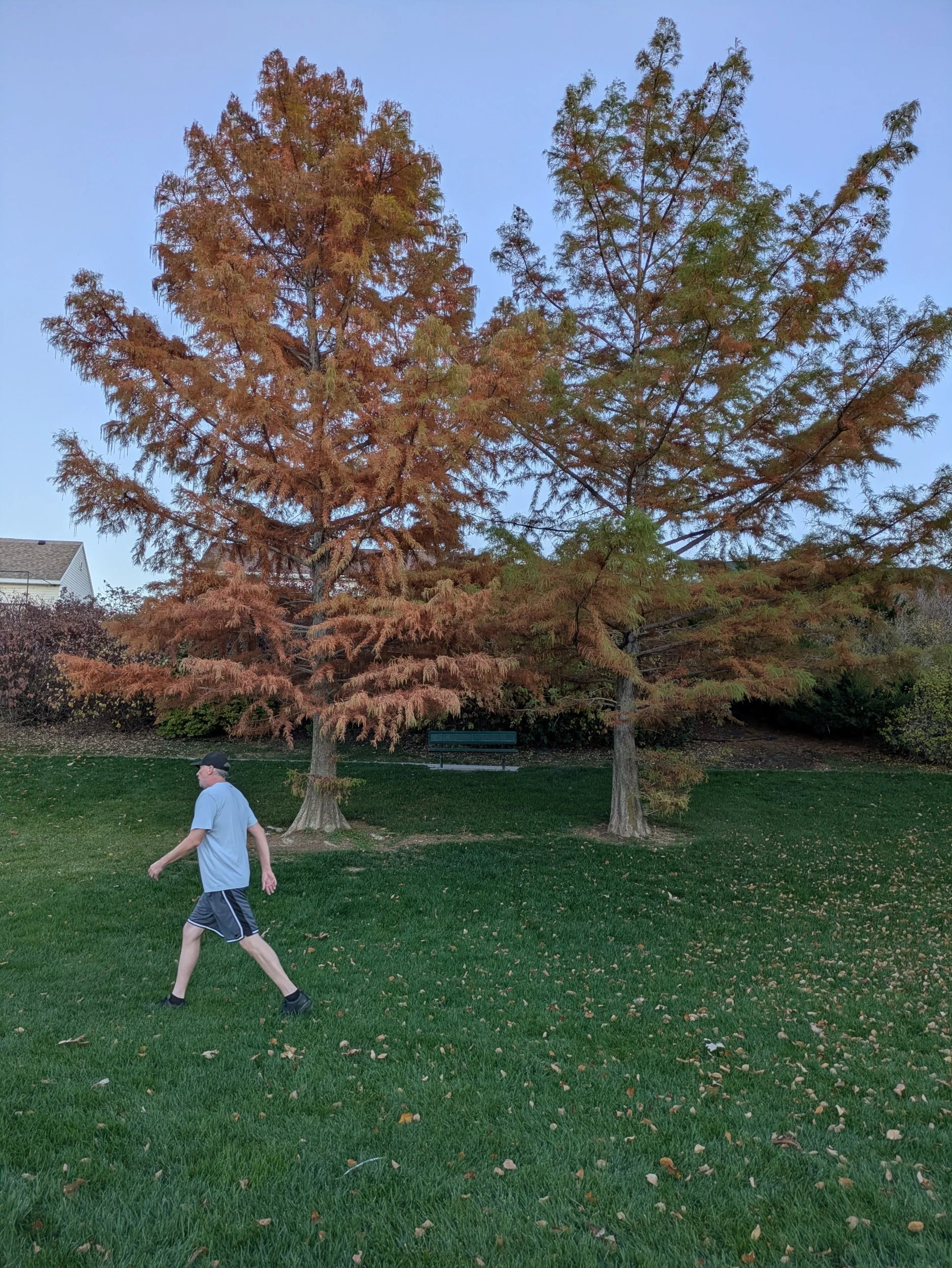
Things I like to do when I only have ten minutes: walking, stretching, something I haven't done in a while, a quick jog to get the heart rate up. And ten minutes is enough to work any single muscle group well, if you stay focused on it.
The bigger point is the cumulative effect. Ten minutes doesn't look like much on its own, but ten minutes repeated over months and years adds up to something much bigger than the sum of its parts. It's the Rodney Dangerfield of workouts — it gets no respect, and it should get a ton of it.
And doing nothing works the same way, just in the opposite direction. When we skip, we stop the momentum. Miss a week and it gets easier to miss another. That's how a habit dies.
So the ten-minute workout has been an invaluable tool for me — not just when life has gotten in the way, but on days when I'm simply not feeling it. Ten minutes, or even less, is always better than nothing.
It's a lot easier to keep exercising than it is to start exercising again.
Fitness for Desk Workers
I have a desk job. If I wanted to, I could sit on my ass for eight hours snacking on potato chips and soda pop. I know exactly what's down that road: weight gain and self-loathing.
But there's something about getting paid while I get a little exercise that feels right.
Most of my day I have to focus on work. That part isn't negotiable. But there's almost always some downtime in there, the question is, what you do with it. Here's what I do with mine.
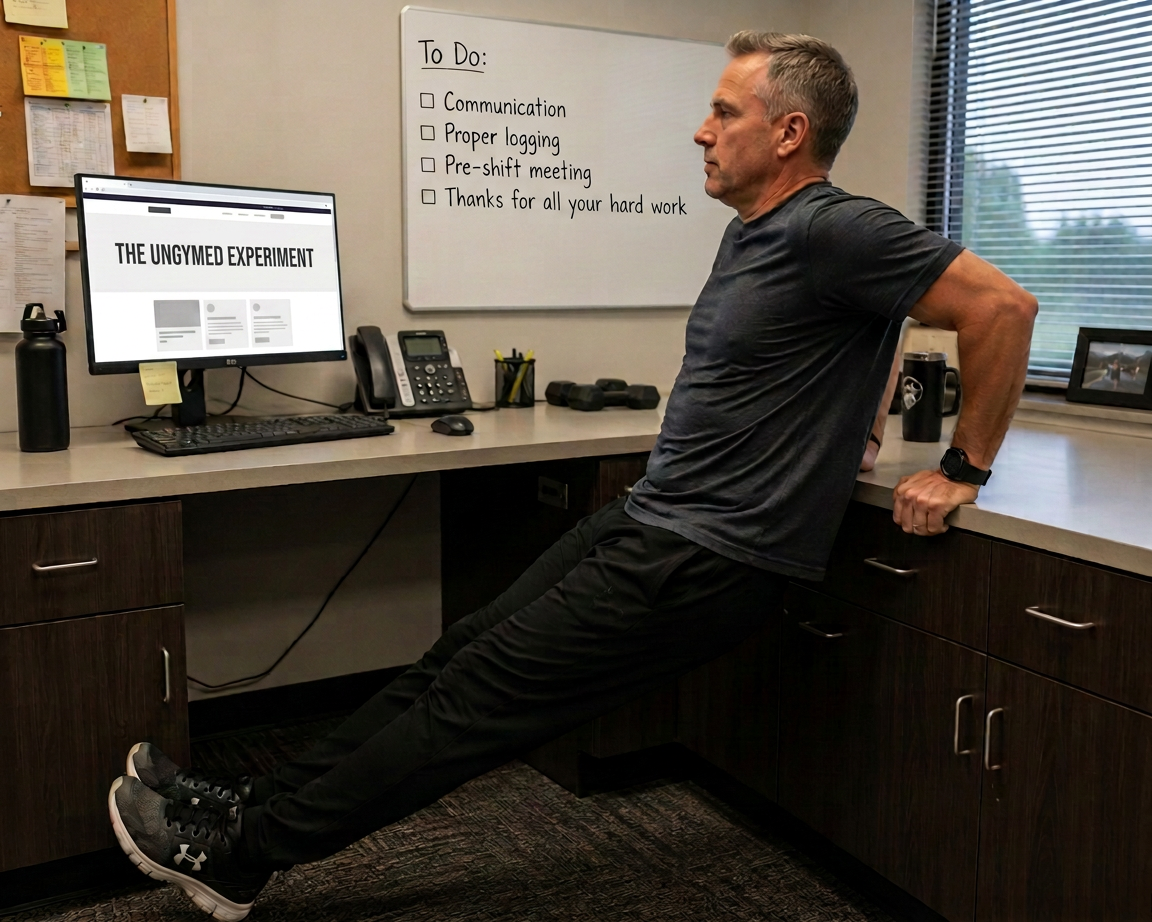
I keep a pair of dumbbells by my desk. When I need a break, I'll do a set of curls or a set of skull crushers. It takes two minutes, and it clears my head better than staring at another screen would.
If I've got a longer gap, I'll do push-ups or dips off the edge of a counter. Sometimes I just walk. And when I have time to carry a couple of dumbbells from one side of the room to the other, that counts too — carries are one of the most underrated things you can do in a workday.
The stress relief is the part I didn't expect. Every day I do a little something at work, and every day it helps.
What You're Allowed to Skip
Two things you're allowed to skip, and both of them are more about permission than logistics.
The first is the gym. If time is short, a home workout does the same job with none of the driving and none of the waiting for a bench. And here's the honest part: once you get used to training at home, you may not go back even when you do have the time.
The second one is the idea that exercise has to happen indoors.
This is the one people laugh at me for, because I'm not an outdoorsy guy. Never have been. Camping, hiking, fresh air for its own sake — none of that was ever my thing.
But I ride my bike outside now. I walk, and I jog when my knees allow it. And I've found a whole world of ways to exercise out there that I never would have guessed I'd like. Honestly, it does something for my mood that the same workout indoors doesn't.
So if you've written off exercising outside because you're not the type, take it from a guy who isn't either. Give it one try. You might surprise yourself.
Summary
"Learning's a gift, even when pain is your teacher." — Michael Jordan
You'll probably have to experiment with your block of time and the days you choose. That's not a failure — it's fine-tuning. Maybe you land on Monday, Wednesday, and Friday from 6:00 to 6:30 p.m. Some of those days you'll use the full thirty minutes. Some days it'll be ten. It all counts.
The routine may evolve, or it may stay exactly the same. Either is fine. The only thing that matters is consistency—not weeks or months of working hard toward a goal, but something you're still doing years from now.
So don't leave it to chance. Schedule it the way you schedule everything else that matters to you. Work, appointments, meeting a friend on Friday at seven — you don't hope those happen, you decide they happen. Exercise deserves the same respect.
Stay patient, stay flexible. Once you discover the rhythm that fits your life, everything else will fall into place.